Contributing authors: Moritz Schneider, Senior Director MR Imaging & Paul Hockings, Senior Scientific Advisor
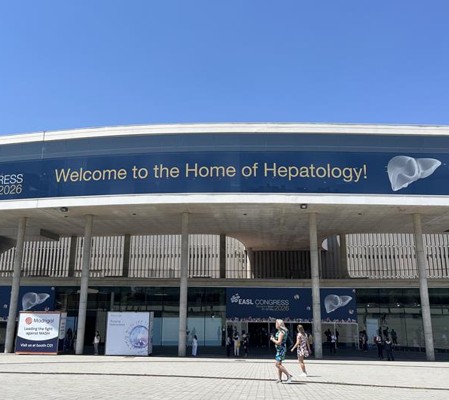
We recently joined more than 7,700 delegates in Barcelona for the European Association for the Study of the Liver (EASL) Congress 2026. It was inspiring to hear about the latest research across liver diseases, including metabolic dysfunction-associated steatotic liver disease (MASLD), metabolic dysfunction-associated steatohepatitis (MASH), and primary sclerosing cholangitis (PSC), to name a few.
One highlight for us was the poster on the latest PDGFRβ PET imaging of fibrogenesis presented by our colleague, Olof Eriksson, CSO at Antaros Tracer. Beyond this, this year’s congress was full of a lot of interesting research. In this blog post, we dive into our focusing on two themes: fibrosis as a true predictor of clinical outcomes, and the growing need to better understand mechanisms of action to inform treatment decisions.
Highlight 1: A focus on fibrosis
Chronic liver diseases are characterised by progressive loss of hepatic function driven by inflammation, cholestasis, or fibrosis. For years, regulatory frameworks have required ‘MASH resolution’ as a primary endpoint. In practice, this has meant the field has relied heavily on invasive liver biopsies to evaluate lobular inflammation and hepatocyte ballooning alongside steatosis and fibrosis.
While the need to move away from liver biopsies has been a major topic of discussion in previous congresses, this year felt like a turning point. New data presented at EASL 2026 strongly suggests that fibrosis is the only independent predictor of all-cause mortality and clinical liver events like decompensation, hepatocellular carcinoma (HCC), and liver transplantation.
This was the core takeaway from abstract OS-097, titled ‘Liver fibrosis is the only predictor of adverse outcomes: time to remove metabolic dysfunction-associated steatohepatitis (MASH) resolution as a clinical trial endpoint’. Presented during the MASLD: Clinical and therapeutic aspects II session, the very large global MASLD study looked at the relationships between histological features of MASH, fibrosis stages, and long-term clinical outcomes.
The findings were clear: only advanced fibrosis (stages F3-F4) independently predicted adverse clinical outcomes. While other classic MASH features correlated with advanced fibrosis, they didn’t independently predict clinical outcomes after the data was adjusted for baseline fibrosis.
This has important implications for how we design liver disease clinical trials moving forward. The hepatology community has been pushing to remove ‘MASH resolution’ as a mandatory regulatory endpoint for some time, and this study provides important evidence to support this. Liver biopsies are invasive, expensive and pose a risk of complications for patients. Due to tissue heterogeneity, they are also susceptible to sampling bias and are limited by inter- and intra-observer variability. moving toward non-invasive tests (NITs) that can be used to assess fibrosis without the need for biopsy, such as blood-based biomarker panels and advanced imaging modalities like magnetic resonance imaging (MRI), offers an exciting development for the future of drug development in liver diseases.
Highlight 2: Spoilt for choice
As several speakers pointed out throughout the congress, it is a very exciting time for treatment possibilities in MASH. For a long time, many presentations at EASL referenced the so-called ‘graveyard’ of MASH compounds, referring to the large number of unsuccessful investigational drugs that didn’t make it all the way to approval. However, at this year’s congress, for the first time the field celebrated the 2 approved treatments for MASH with moderate to advanced fibrosis.
Having options is a great thing, but it does present a new challenge in the need to make choices between compounds for individual patients. Making such a decision requires an understanding of specific mechanisms of action in addition to how treatment effects differ. This was a recurring theme across sessions but was perhaps most comprehensively reviewed during the Satellite Symposium, ‘GSK: The steatotic liver disease care mosaic: Assembling the big picture’.
The discussion was largely centred around the different mechanisms of action; a liver-directed thyroid hormone receptor-beta agonist, which mimics thyroid hormones in the liver, and a glucagon-like peptide-1 (GLP-1) receptor agonist which is also approved for the treatment of type 2 diabetes (T2D) and obesity. Both treatments have shown beneficial effects in the liver, but their different mechanisms of action raise important questions about patient selection, sequential treatment strategies, and where combination treatments might fit in.
This highlighted the importance of understanding how treatments achieve their beneficial liver effects. By using imaging biomarkers, it is possible to look at precise, specific changes in disease pathology., Whether we are measuring liver fat (MRI-PDFF), liver stiffness (MRE), fibrogenesis (PDGFRβ PET), liver function (gadoxetate-enhanced MRI), advanced imaging is going to be essential for tailoring treatments to the patients who will benefit most.
Closing thoughts
EASL 2026 featured a lot of scientific progress in hepatology. Reflecting on the event, two major highlights stand out:
- A focus on fibrosis: advanced liver fibrosis has been identified as the only true predictor of adverse outcomes, challenging traditional clinical trial endpoint design.
- Spoilt for choice: the availability of multiple MASH therapies has spurred the need to understand different mechanisms of action to enable informed treatment decisions.
We’re already looking forward to seeing how these discussions have evolved by the time the field gathers for next year’s EASL Congress in London, UK.
Blog disclaimer:
The views and opinions expressed in this article are solely those of the contributing author/s. These views and opinions do not necessarily represent those of Antaros Medical.
Contact details:
If you have any questions regarding this article, please reach out to press@antarosmedical.com